Data Science · AI · Research

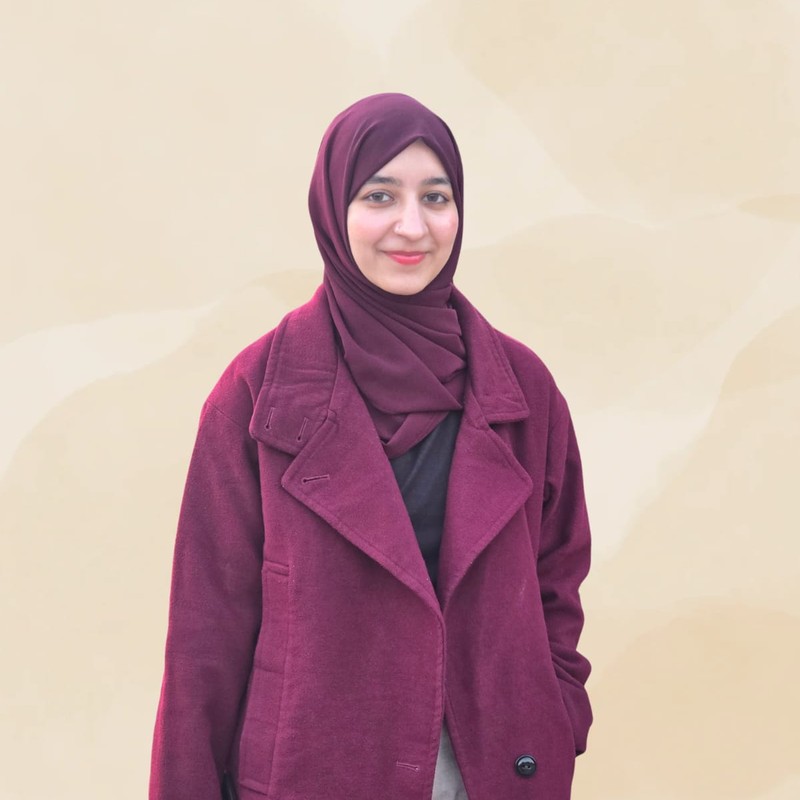
Hira Baig

Building intelligent systems through data, machine learning, and research, work built to survive contact with real users, not just a benchmark.

Hira Baig
BS Data Science · '27
PythonScikit-learnXGBoostSHAPNLPLangChainComputer VisionDeep LearningNext.jsReactNode.jsTypeScriptTailwind CSSPostgreSQLSupabaseMySQLPower BIData VisualizationExperimental DesignStatistical EvaluationExplainability AnalysisFederated LearningPythonScikit-learnXGBoostSHAPNLPLangChainComputer VisionDeep LearningNext.jsReactNode.jsTypeScriptTailwind CSSPostgreSQLSupabaseMySQLPower BIData VisualizationExperimental DesignStatistical EvaluationExplainability AnalysisFederated Learning

01 / ABOUT

A sideways path into AI research.

I didn't start out planning to work in artificial intelligence. I completed pre-medical secondary education with a distinction in Biology, expecting to study medicine, and the move into Data Science that followed was neither planned nor smooth, and my first years of the degree show it.

What matters more to me than that early record is what came after: as I built confidence in programming and quantitative reasoning, my academic performance recovered and then strengthened considerably. That recovery coincided with the point I stopped treating AI as a subject to pass and started treating it as a set of open problems, specifically, what happens to a model once it leaves the clean conditions of a benchmark.

◈

Reliability over demos

A model that works in a benchmark and not in the real world hasn't solved the problem. I test for the messy middle, not just the happy path.

◇

Explainability

If a prediction can't be explained, it can't be trusted with a real decision, especially in healthcare. Evidence over accuracy scores alone.

◆

Ship real systems

Research questions are more honest when they come from a system real users touch, verification, matching, dashboards, not just notebooks.

○

Lifelong learning

I came into this field sideways, from Biology. Staying curious about what I don't know yet is the whole strategy.

02 / EXPERIENCE

Teaching, and building on the side.

Alongside my degree and research, I've spent close to four years teaching, and a couple of years building web products for clients before that.

Sep 2026 – Present

Online Tutor

Nexus Academy (UK)

Selected to deliver Biology and Computer Science tutoring to IGCSE and A-Level students.

2023 – Present

Private Tutor, Biology & Computer Science

Online

Mentored international students one-on-one through concept-based, personalized instruction.

Aug 2023 – Feb 2025

Biology Teacher

Encore Star Academy

Delivered concept-driven Biology instruction to FSc and A-Level students through interactive, student-centered methods.

Jul 2021 – Jan 2023

Freelance Web Developer

Upwork & Fiverr

Delivered end-to-end web development, graphic design, and video editing solutions for international clients.

03 / EDUCATION

The credentials, for the record.

01

2023 – Expected Feb 2027

BS Data Science

COMSATS University Islamabad

Focused on machine learning, AI, and data engineering. Research on federated learning and healthcare AI; final-year project QaamQaaj.

02

2019 – 2021

FSc Pre-Medical

Islamabad Model College for Girls, F-7/2

Distinction in Biology, the foundation for my continued interest in healthcare and biomedical AI.

03

2017 – 2019

Matriculation in Science

The Educators School

Broad grounding in physics, chemistry, biology, and mathematics.

04 / RESEARCH

Making healthcare AI worth trusting.

Most of my research sits at the intersection of machine learning and healthcare, where a wrong prediction isn't a bad metric, it's a bad decision about a real patient. I care less about squeezing out another accuracy point than about whether a model's output can survive being questioned.

Trustworthy & explainable machine learningRobustness under real-world distribution shiftPrivacy-preserving & federated learningHealthcare & biomedical AI
01

Privacy-preserving federated learning for secure, sustainable AI

Published

International Journal of Advanced Research · 2026

02

The Role of Artificial Intelligence in Early Disease Detection and Diagnosis

Under Review

Baig, H., & Dawood, O. B.

Manuscript under review · 2026

05 / WORK

Systems, not just models.

From research prototypes to production-facing platforms, the common thread is testing whether an idea holds up once real users and messy data get involved.

01 / 04In Progress

QaamQaaj

My final year project, supervised by Prof. Dr. Manzoor Elahi Tamimi, building an AI-enabled platform that matches skilled workers with employers across Pakistan's informal labor market. I designed the identity verification pipeline, combining CNIC OCR with face matching so workers can be onboarded and trusted without traditional paperwork, alongside an AI-driven job-worker matching engine that factors in fraud-detection signals to keep the marketplace safe. To reach workers with low digital literacy, the platform also includes an AI/IVR calling bot so people can register and get matched over a simple phone call, not just through the web or mobile app. A core part of my research on this project looks at cross-modality consistency, making sure identity signals extracted from a CNIC, a live photo, and a voice call all agree with each other before trust is granted.

Next.jsSupabasePythonComputer VisionNLP
02 / 04Research

BioXplain

A research project that grew out of my background in Biology, applying SHAP-based explainability to gene-expression-based disease classification. I compared how several classical ML classifiers, including logistic regression, random forest, XGBoost, and SVM, arrive at their predictions, rather than only comparing how accurate they are. The focus is on whether the feature attributions each model produces stay stable and biologically plausible across models, since a model that is accurate but points to the wrong genes is far less useful in a biomedical setting than one that is both accurate and explainable.

PythonScikit-learnXGBoostSHAP
03 / 04Live

Multi-Modal Health Assistant

An AI-powered health assessment system I built with Python, LangChain, and Streamlit, combining structured health data (things like BMI, age, and blood glucose) with NLP-based analysis of a user's described symptoms to deliver a diabetes-risk prediction. Rather than returning a single opaque score, the assistant explains which factors drove the assessment and pairs that with personalized recommendations, so the output is something a user can actually understand and act on.

PythonLangChainStreamlitNLP
04 / 04Live

CareerAI

A career guidance web app built with Next.js, React, and TypeScript, wired up to AI APIs to analyze a user's profile and recommend personalized career paths. It runs a skill-gap analysis against a user's target role, then surfaces relevant learning resources for exactly the skills they're missing, turning a vague "what should I learn next" question into a concrete, prioritized plan.

Next.jsReactTypeScriptAI APIs

06 / BEYOND THE CODE

Credentials, leadership, and a bit of life.

Certifications

Introduction to SQL

Kaggle

Introduction to Networks

Cisco

Data Analytics

Coursera (Google)

Build AI Agents Using LangGraph

Simplilearn

Power BI for Beginners

Microsoft

Leadership & Activities

Vice President

Industrial Liaison Cell, COMSATS University Islamabad · 2026

Design Team Member

Data Science Society, COMSATS University Islamabad · 2025

Event Management Co-Head

Hult Prize Foundation · 2025

Event Management Co-Lead

Industrial Liaison Cell, COMSATS University Islamabad · 2025

07 / CONTACT

Let's talk.

Research collaboration, project ideas, or opportunities, reach out through any of these.